Agent architecture
The Cyberphiz platform was designed to address the technical challenge of creating an agent architecture that incorporates continuous causal monitoring, physics-based inference, and root cause analysis.
Industrial specialized Agents
The Cyberphiz architecture deploys a coordinated network of specialized agents, each focused on a specific inference domain. These agents communicate through a shared knowledge substrate called the Cyber-Physical State Store.
The rationale for each design choice is grounded in the specific requirements of the industrial risk domain.
Asset Discovery and Graph Construction Agents
The foundational inference task in any industrial risk model is establishing an accurate, current representation of what physical and digital assets exist in the facility. Agents are responsible for constructing and maintaining the digital twin graph. This step is architecturally significant: discrepancies between the engineering documentation model and the live telemetry model are themselves risk signals, indicating either that the facility has been modified without documentation updates (a maintenance risk indicator) or that assets present in the live network are absent from the authorized equipment register (a potential shadow OT risk).
Physics-Informed Inference Agents
The physics layer is where the Cyberphiz architecture most fundamentally diverges from conventional agentic patterns. Deterministic laws of physics govern possible outcomes given the system's current physical state. Physics Validation Agents implement this constraint layer. Their core function is to evaluate every candidate risk scenario—generated either by threat intelligence agents or by anomaly signals from monitoring agents—against a set of physics-informed process models that encode the thermodynamic, fluid dynamic, and electrical constraints governing the specific industrial processes present in the facility.
Threat Intelligence Agents
The primary function of these agents is to construct attack path models: directed graphs from plausible network entry points through exploitable control system vulnerabilities to the specific physical actuators and sensors that the exploitation of those vulnerabilities would affect. They operate on the asset graph maintained by the Tier 1 agents, traversing it from vulnerability nodes through control dependency edges to actuator and sensor nodes.
Loss Modeling Agents
Probabilistic Loss Modeling Agent translate physically validated, causally grounded risk scenarios into explicit financial probability distributions.
Governance Architecture
The Human-in-the-Loop Requirement
The current governance model governing the Cyberphiz idustrial agent network is founded on a principle that agents are inference engines, not decision-makers. The architecture enforces this principle through structural constraints on the agent-to-action pathway, not through policy documentation or usage guidelines.
Explainability as a Structural Property
Explainability in the Cyberphiz architecture is a structural property of the agent network: because every inference step is mediated by a documented tool call (to the physics simulation engine, to the asset graph query interface, to the threat intelligence database, or to the state store), every output can be traced to the specific data sources and computational operations that produced it. The agent's reasoning is a documented sequence of tool calls with their inputs, outputs, and the natural-language reasoning that connected them.
Non-Invasive Sensor Integration
One deployment constraint that distinguishes industrial AI agent systems from enterprise AI deployments is the requirement that the monitoring infrastructure not create a new point of vulnerability in the OT environment it is designed to protect. The Cyberphiz deployment architecture addresses this constraint through a passive, read-only integration model. The platform does not deploy software agents within the OT network perimeter. Instead, it connects to data sources that are already available outside the OT perimeter.
The Industrial Grounding Stack
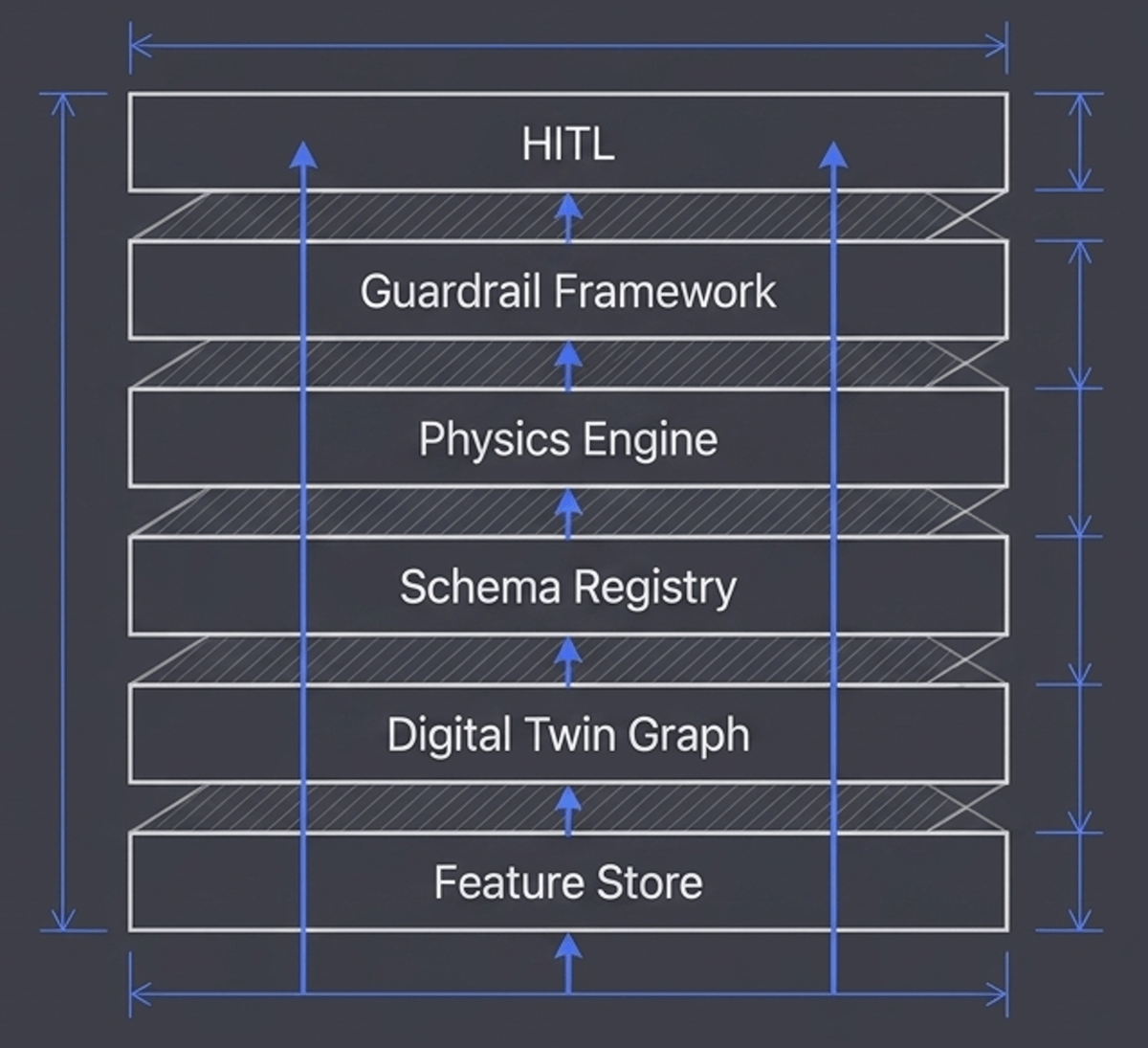
Without the Industrial Grounding Stack, an agent can reason — but it cannot reason safely about physical systems. With it, every agent hypothesis is validated against physical reality, every data input is governed and typed, and every consequential action requires human authorization.
Without the Industrial Grounding Stack, industrial agentic AI is neither safe nor insurable. An agent that can reason but cannot validate its reasoning against physics will eventually produce a recommendation that sounds plausible but is physically impossible — and in a safety-critical environment, a physically impossible recommendation that is acted upon leads to equipment damage, environmental release, or personnel injury.
The Grounding Stack is what converts an agentic AI system from a sophisticated analytics tool into a trusted operational partner. It ensures that every agent output is physically plausible (Physics Engine), relationally coherent (Digital Twin Graph), data-quality validated (Feature Store), type-safe (Schema Registry), continuously monitored (Guardrail Framework), and human-authorized for consequential actions (HITL). These are not optional sophistications — they are the minimum requirements for deploying reasoning agents in indistrial environments.